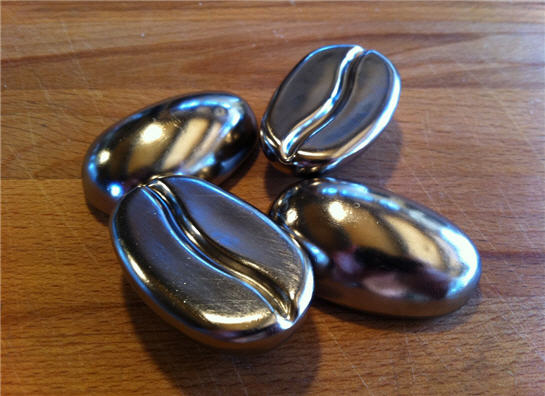
Edit: As noted in the comments, I’m testing these under a situation which is not the recommended method from the Joulies company. I am, however, testing them in the real-world situation in which I would most likely use the Joulies. I wanted to add this disclaimer to be fair to the guys struggling to turn this into a company. I stand by my results, but leave you to make the decision about how well the Joulies would meet your needs for the product.
Abstract: I recently received my set of Coffee Joulies (http://www.joulies.com/) after putting some money into their Kickstarter project. Excited to review and test them out, I came up with a simple experiment. I tested the Joulies vs. an empty control mug with just hot water vs. a mug with rocks of roughly equivalent size to the Joulies. Both the Joulies and the rocks dropped roughly 30 degrees in temperature immediately and then lost steadily at the same rate. The cup with just water didn’t see the immediate drop, but lost temperature steadily. I saw no significant or noticeable difference between the rocks and the Joulies. Given that the Joulies cost $50 and the rocks cost me walking out into the front yard, I’m skeptical about the value of the Joulies.
Method:
After finding 3 mugs of identical size and shape, I went out in the yard to find a handful of rocks which closely matched the volume of the Joulies. Following this, I set all 3 mugs up on the same wooden coffee table surface. I left the mugs, rocks, and Joulies overnight to allow them to equalize to room temperature.
The following day I boiled enough water to fill all three mugs in an electric tea pot. Once finished, I began the testing. Filling the first of the three mugs (the empty one). I started my stopwatch. I measured the temperature immediately using a digital meat thermometer. My method for obtaining temperatures was thus: place the thermometer in the water in the corner opposite the handle (all mugs were oriented the same way), then watch the temperature until it flattened out and began dropping. I measured the temperature as the maximum before the drop. Typically it only wavered by a degree or so.
Thirty seconds later I poured the next mug (with the rocks) and repeated the measurement for it, I then did the same with the 3rd mug (with the Joulies). By doing it thus, I was able to measure all of the mugs at the same elapsed times. I then continued this process at intervals until reaching 1 hour.
Results:
As usual, a graph is worth a thousand words. I’ve broken them up into two different graphs to prevent distortion from having changed from measurements every 2 minutes to every 4 minutes at the 20 minutes mark.
Minutes 0-20
Minutes 20-60
No that we can see the behavior of the 3 mugs and their contents, let’s examine some claims from the Joulie website.
1) “Their polished stainless steel shells are full of a very special phase change material (an ingredient in food) that melts at 140°F. When you put them in your coffee this PCM begins melting, absorbing a LOT of heat in the process and cooling your coffee down much faster than normal.”
I can’t argue with this, they did indeed rapidly cool the hot water down. However, the rocks and the Joulies had roughly the same effect in this regard.
2) “When your coffee reaches 140°F (the perfect drinking temperature) the molten PCM [Phase Change Material] begins solidifying again, releasing all that energy back into your coffee to keep it at a comfortable and delicious drinking temperature. The more heat you feed your Joulies, the longer they’ll keep your coffee warm.”
The Joulies behaved almost identically to the rocks and as such do not seem to have had any sort of magical technology. In fact, after the initial drop, the rocks maintained a higher temperature for a longer period of time. Also worth noting, the slope of the rocks and Joulie lines were very similar, showing a large initial drop and then a steady decline.
Obviously, this is a fairly limited experiment and it would be helpful to perform with various other size containers and materials. However, I do think that it is enough to show that the Joulies are not some sort of magical material. While there may indeed be some sort of special materials inside, the effects they had were not enough to be noticeable in a real life situation, and therefore do not justify the cost of the Joulies over simply buying a more massive mug.
Edit: A friend just sent me this similar post on testing and reviewing of Joulies by Marco Arment
Edit 1/15/12: Here’s another interesting article on the subject.
 Jeff Ammons
Thanks for the experiment. I’ve thought about doing one myself, but I never thought of using rocks. One advantage of the joulies over rocks is sanitation, if only perceived. For instance, you’d want to be able to reassure your friend that the rocks are not going to contaminate their coffee when you serve it to them. Not saying it’s worth $50, and you could probably find rocks that appear clean without spending a lot of money. When it’s just for me, the only value is that the stainless steel joulies are easier to keep clean than rocks, and less likely to scratch my steel mug.
I have coffee joulies, like you, as a result of kick starting, and I have found them useful. I notice they work better in a sealed vacuum container than a mug. I usually only drink one cup of coffee a day, and I take several hours to drink it. I really like that I don’t have to wait 10-15 minutes before the coffee is drinkable. And it stays at a drinkable temperature in my Contigo mug for several hours. Basically from when I get to work, until lunch. Coffee Joulies’ web site implies that a sealed container works best, and it appears that the heat lost to the environment in an open mug overcomes the value of the phase change material. I wonder then if your rocks mimic the joulies sufficiently in an open mug. What if you conduted the same experiment with sealed mugs such as Contigo, or the like?
There is another value, but it’s merely social. I’ve been able to answer the “what are those things you’re putting in your coffee?” question from co-workers and sound very coffee-hip and scientific. For me, it’s not so much about swelling my ego, but about having a light-hearted and natural conversation starter.
Were they worth $50 as a practical consumer purchase? No. Were they worth $50 to kick start a very creative idea and help test it out, and be the first guy at my company and in my family to have this cool new coffee thingie? Yes. 🙂
Happy coffee drinking, and thanks for the data! Let me know if you follow up with the experiment in sealed thermal containers.
LikeLike
Carl: I think boiling the rocks should make them as sanitary as possible. I like the idea of kickstarting projects, but not when they’re falsely advertising “scientific” progress. Seems to me that this is counterproductive.
LikeLike
There are stainless steel whiskey stones or stainless chillballs for around $20 for a set. They are advertised as having a gel in them, and you put them in the freezer to keep drinks cold versus using ice that will dillute your drink. I wonder how these would compare to the Joulies.
LikeLike
I invested in the Kickstarter program and bought these for my wife, who immediately puts ice in her tea after brewing because it’s too hot for her. I thought these would be great for that quick temp drop and then holding the tea warm. When I got them, I was surprised at their size, thinking they will take up a lot of space, obviously leaving less for tea.
How many rocks and Joulies did you use?
Also, maybe their advertising should be, “As effective as rocks, only sanitary!” : )
LikeLike
Dustin: I used all 5 Joulies and the rocks were roughly the same volume as the joulies.
LikeLike
Can I buy some of your rocks?
LikeLike
For what it’s worth, commenters on my post about Joulies,
http://www.leancrew.com/all-this/2011/08/coffee-tea-and-joulies/
suggested that the magic phase change material was simply paraffin wax, a material whose heat of fusion isn’t high enough to hold the temperature of the coffee, especially in an open-topped cup.
LikeLike
Hey Jeff,
Did you pour the same amount of liquid into each cup? Less water loses heat more rapidly, doesn’t it? Might make the difference between just water and the others even less…
Cheers, Stefan
LikeLike
I did use the same amount of water in each cup, give or take a few mL. I was not terribly precise on this, but it wouldn’t have been enough to effect results more than a few % at maximum.
LikeLike
Can you weigh the rocks and the joulies? Also, did you put the same volume of water in all mugs – or fill each mug?
— Izzy told me to ask.
LikeLike
Ryan: I unfortunately don’t have a scale, so I can’t say more than that they were approximately the same volume.
LikeLike
Awesome. I love that you tested rocks as well, which I’d thought of too but never got around to.
To be fair your first graph DOES look like they have a store and transfer of energy around 130 or140 degrees from minute 4-6 but its in the noise enough to be negligible
LikeLike
The flat part of the 0 – 20 min “Rocks” curve actually looks more like phase change behavior than does the “Joulies” curve (any chance you could have reversed those?)
LikeLike
Mark: Yeah, I noticed that as well.
LikeLike
The clear scientific conclusion is that the rocks in your yard are made from an _even more special_ phase change material. Who’d a thunk it?
LikeLike
Dr. Drang: I just read your post. I like it. I’m adding a link.
LikeLike
I have read a number of reviews concerning Joulies, and for the most part the negative comments are being made based on experiments using coffee mugs. That is not what Joulies are best used for. They have a hard time storing heat energy when the liquid is in a vessel that leaches heat at a great rate as well as exposing the liquid to the air.
Joulies work best (and are recommended to be used) in an insulated vessel with a lid, such as a foam take away cup, and they excel in a vacuum thermos bottle. When used that way they do exactly what they are intended to do. They lower the temperature of a very hot liquid (in this case, coffee) to a drinkable temperature and hold the liquid in a drinkable range longer than if they had not been used.
Feel free to read my review which includes a graph from data I collected simultaneously from two insulated mugs holding the identical volume of hot water – one with Joulies (4 per 16 ounces in accordance with the recommended one Joulie to about 4 ounces of liquid) and one without, data logged on a two channel digital meter. Review at:
http://www.frcndigital.com/coffee/joulies.html
LikeLike
That may be so, but I would argue that the value of Joulies vs. rocks in the same situation would likely be quite comprable.
LikeLike
interesting experiment. One thing to notice is the cooling slope is the same for all three. I am therefor confident the method of cooling to be the same in each case. Convective cooling from the surface is most likely with cooling from the walls of the cup being the second. If an insulated mug with a top were to be used, the results would be quite different. If the material absorbs the heat, it has to give it off. Any material will do, it is just the state change makes it better than non state change materials. I don’t know if they are worth $10 each but good luck to them.
LikeLike
Seems like all the ferver has died down on this issue. However, this is actually a very simple heat conservation calculation. If either rocks or joulies are used in an insulated container, the temperature will drop faster and the container heat dissapation/loss will be somewhat slower due to the lower heat transfer from a lower delta T achieved via additions of foreign items in the system vs. no additions. Assuming no other heat loss(insulated container), this will be the only benefit and therefore, there is no real advantage in using phase change vs rocks. The only justification for using phase change is in the situation where anything above 140 is undrinkable(too hot), therefore, maintaining it at 140F is crucial. In real life, this is never the case.
LikeLike
Thank you so much for doing this experiment! You saved me $50 bucks!
LikeLike
Let me try this theoretically using what I am now studying in General Chem:
Paraffin is a typical non-toxic phase-change material (PCM) in these applications, and looks like the filling in cross-sectional photos of the Joulies. Let’s estimate that five Joulies contain a total of 50g of paraffin, a wax with a typical latent heat of fusion of 200 J/g. That means that as the coffee cools, and the paraffin re-solidifies, it will return 10KJ of energy to the coffee.
American coffee (ie: water) has a specific heat of 4.2J/gºC, and let’s say we take 300mL of it. Our 10Kj of energy will heat the liquid by just under 4ºC (10,000/4.3/300). …A modest gain.
Jeff’s rocks, above, acted as a heat sink; albeit one about a third as good as the paraffin (despite the greater mass), and had no latent heat to return to the coffee. The wax should take in 1300J/ºC, and the rock about 460J/ºC (paraffin: 2.9j/gºC at a density of 9g/mL, and rock 0.84j/gºC with density of 11g/mL).
So, in theory anyway, you’re better off using the Joulies; they’ll cool your coffee down 3x as much as the rocks do at the outset, and then you’ll get 4ºC back over time from the phase change. Not big total effect in practice, but better than the rocks. This seems to jibe Jeff’s experimental data too.
…I’m getting a rotten grade in Chem, so don’t give this too much credence, OK?
LikeLike
Thank you you just saved me 59.99
LikeLike
Hi Jeff – for clarification, how many times can you use 1 rock? Thanks!
LikeLike
If joules WORKED, Lord Joules AND laws of thermodynamics would be laughed out of town!
LikeLike